Matina Weeks
I couldn’t have been more than fifteen or sixteen. Sitting in the corner of the living room with a couple of high school friends and gabbing away, I dropped the comment, “Well, for me, I definitely don’t want to ever have kids.”
“Matina! How could you say that?” my mom interjected from across the room. Oh gosh, I thought, I didn’t think she was listening. “Don’t you know what it means to be a true woman?” she went on, as I tuned her out and rolled my eyes to save face in front of my girlfriends. “OK mom, whatever…”
But that phrase kept haunting me. I knew for sure that I didn’t want to do what I saw all of the women around me doing: getting married and having baby after baby with no time left over for themselves. I was going to go somewhere in life, no question about it. I devoted all of my energy to art, spending hours pouring over books of paintings by great masters. On a trip to New York, to the Metropolitan Museum of Art, I stumbled across a figure entitled (if I remember rightly) “Mother Earth” – a well-rounded, buxom woman sitting with her broad feet firmly planted on the ground and cradling a small child. I stayed for a long time in front of this sculpture, unable to tear myself away. As I stood there, I felt a little nagging doubt that maybe I was missing something. I was, at the time, ambitious and arrogant, driven, and flirting with an eating disorder. The depth of womanhood represented here shook my little world. My mother’s question echoed in my head.
But it didn’t last long. I was sold on the modern image of womanhood: intelligent, successful, and of course, sexy; and I did all I could to become that way. I left home, went to college, and on the surface I did fine. Underneath, though, even if I hardly dared admit it to myself, my life was in shambles. I was rapidly losing any sense of right or wrong. Addicted to flattery, I flitted from relationship to relationship without a thought for the heartache and torment I was causing. Eventually I came home, broken and confused, and wondering where it had all gone so wrong.
It was then that my mother’s question took on a life of its own. Confronted with my own blatant shallowness, I began to look for answers. Perhaps, I thought, there is something in what my mother was trying to tell me so long ago. How many of us women long for something more than what Madison Avenue—or the local shopping mall—has to offer? How many of us are frustrated with trying to live up to the demands of a society that dictates our lives right down to our body size? How many of us become aggressive and commandeering out of self-defense? Is there another way?
The answers I started getting were no easier than the questions had been. I began to feel that the only truly liberated woman is the one who is open to fulfilling God’s plan for her life. And I was afraid that that was the image of womanhood my mother had been trying to point me to. I felt certain that it would mean loss of control over my life. And once I lost that, what would keep someone from taking advantage of me? After all, I had taken advantage of countless people before….
Over time, I realized that my entire mode of operating would have to change. Being womanly was not a cop-out, something only for those who couldn’t keep it all together. It was the hardest and noblest undertaking that I could imagine. My survival techniques had to be dismantled. For a long time I had suppressed the desire to be a nurturer—to show love—as a threatening one. Vulnerability was never high on my list of sought-after qualities, but now I found myself embracing it rather than rejecting it. I realized that perhaps one of the greatest strengths of a woman lies in her sensitivity and care of other people, not in her control of them.
There were a lot of things I had to unlearn, and at twenty-four I can’t say that I’ve gotten very far. But I have definitely set out on a different road from the one I was taking in high school. I still find myself fighting with the need to assert myself, to win every argument, to run over men who don’t show strong leadership.
Friends have helped me a lot. A close friend confided in me that she can distinctly remember how free and proud she felt when she gave up maintaining her perfect image. “It was so good to step out and know that guys weren’t looking me up and down checking me out. I felt like I had just removed myself from that whole game, and I could finally really relate to people again.” Another friend told me she had decided to live up to the example of her grandmother, and found she needed to give up a lot to do so. “I had to surrender my need to achieve, to be equal with men, to diet. But,” she went on, “in a world where our little girls see no other options than to grow up as submissive, adored objects of desire or aggressive commandeering she-wolfs, I am determined to let them know there is a third way.”
As for me, stepping out of the usual stereotypes hasn’t been easy. I can’t stand aloof and ignore the injustices that gave rise to the notion of feminism and its varied expressions in today’s world. Whether women see themselves as victims or controllers, it doesn’t really make a difference—no one can deny that there is a huge rift between the sexes that needs to be reconciled. But even if it is an unpopular point of view, I think the only way that rift can begin to be healed is if we women recognize that we are not guiltless. We need to change too.
As much as men fail to respect and honor the women around them, we need to see that we fail them too. We need to stop looking at men for what we can get out of them and at how we can wrap them around our fingers. We need to begin to see them as brothers and co-workers. Only then can we demand that they treat us with the same love. And then, perhaps, we will be able to put aside our old fears, and find a new freedom: the freedom to listen to our own consciences, and to become more fully human.

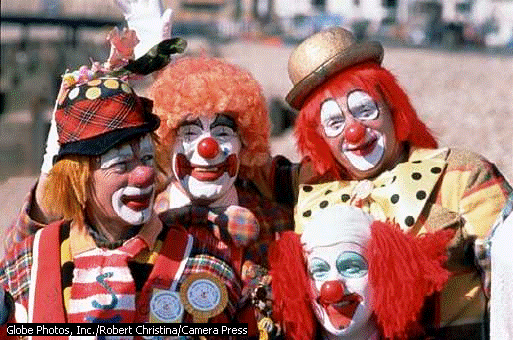 Clown, performer, usually in a circus, who plays the fool, performs practical jokes, and does tricks to make people laugh. Other names for clowns include buffoon, jester, fool, comedian, conjurer, tumbler, harlequin, comic, and puppeteer. Although there are many types of clowns, each clown develops a “face”, meaning a performance personality. A clown’s face, once established, becomes the clown’s unique personal property.